Meet Lia: Building LibreChat with LibreChat
How Lia is helping me build LibreChat with LibreChat, what recent agent features make possible, and where I want the project to go next.


I want to introduce Lia. Her name stands for Libre Inteligencia Artificial, and she is powered by LibreChat.
Giving an agent a name and an avatar is easy, and we did this back in 2024. What matters to me is that I now do much of my agentic coding work on LibreChat in LibreChat. The project we have spent years building is becoming a place where we can build the project itself.
Claude Code, Codex, and Cursor have helped me build LibreChat. I do not want our development workflow tied to any of these coding clients. Lia is how we are starting to unshackle ourselves from that dependency: moving the work into LibreChat, where we can choose models, run tools on infrastructure we control, and inspect and steer what happens.
When I first described our mission as “AI for Everyone,” I was thinking primarily about people who do not write software or use developer tools in their daily work. I still am. But engineers are part of everyone, too. The same freedom and control should extend to the people using agents to write software.
Lia brings those ideas together. She is not a separate product or a claim that the work is finished. She is a way to show what LibreChat's agents can already do, and a direction for the many kinds of agents we want the platform to support.
Every iteration on LibreChat, every new capability gained, can be personified as an extension of Lia's abilities and identity.
At the time of writing, we are finalizing v0.8.8 and aiming to release it today. I wanted to introduce Lia ahead of that release. Setting her up spans multiple repositories, so I will follow up after the release with a separate technical post showing how the pieces fit together.
Taking control of our coding workflow
Agentic coding needs more than an agent that can run commands. It needs a code workspace, ways to ask questions and delegate work, boundaries around sensitive actions, and a clear record of what happened.
That is the agent workspace we have been building. Agents can work with attached code workspaces, use Skills and tools, ask for clarification, and continue longer-running work. People can follow activity, steer a run, and review execution when approval is required. Attached workspaces remain highly experimental; they are useful today, and we are still refining how they work.
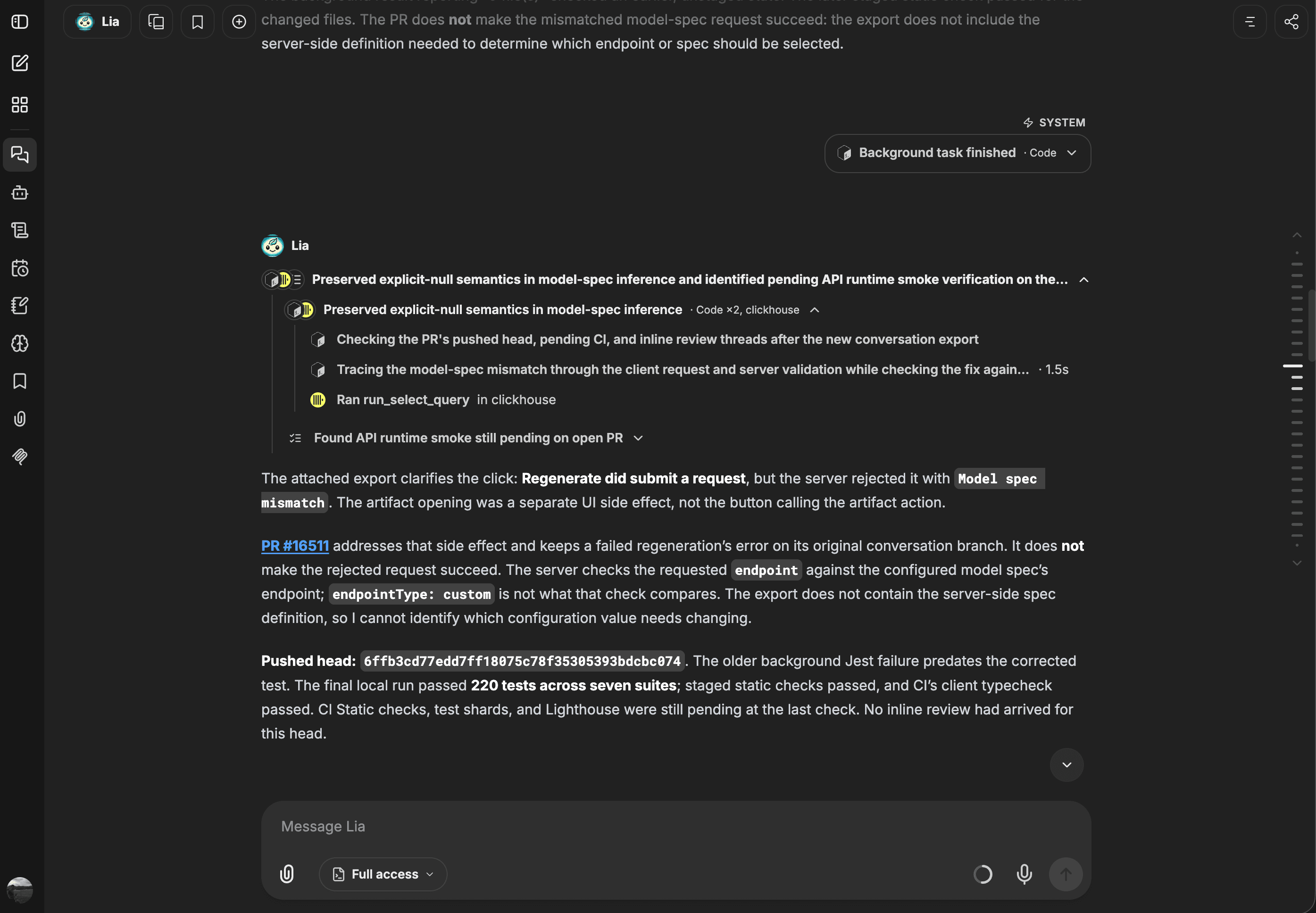
Lia at work in LibreChat: tracing a model-spec issue, checking a pull request, and reporting what still needs verification.
We are also developing durable Agent Events, including ways for work to reach an agent from outside an active chat. Paired with background execution, this opens the door to agents that respond to an event, do useful work, and report an outcome without requiring someone to start and poll every run manually.
What the recent releases made possible
The August and September release candidates brought changes that make more sense together than as a long list of features:
- Agent work is easier to follow. Activity phases show what an agent is doing. With Langfuse tracing configured, the conversation Trace Viewer can show a sampled run's tool steps and costs. Langfuse is an open-source platform for tracing and analyzing AI applications; deeper integration will help us use those traces to refine agents.
- Human review is taking shape. Agents can pause to ask people questions, and we have laid the initial UI groundwork for managing tool approvals before sensitive actions run. I want to extend that human-in-the-loop control to more advanced approval policies that consider tool inputs and outputs.
- Longer tasks have better continuity. Subagents, background work, and context improvements help an agent carry work forward when a task outlasts a single exchange.
- Coding has a place to happen. Stateful code sessions and attached workspaces let agents inspect files and work in a chosen environment. A workspace can be configured on any number of machines, with different scopes, no matter how or where your LibreChat instance is served.
- LibreChat is easier to extend. The Agents API lets applications interact with agents programmatically and includes endpoints for managing Agents. Skill authoring makes reusable instructions easier to create.
The Agents API, Subagents, and Handoffs are still in beta, even where they appeared in stable releases. We plan to move them out of beta in the next release. Bring Your Own Machine (BYOM) coding is also beta, with attached workspaces remaining highly experimental.
These are highlights, not a substitute for the full changelog. They are the pieces coming together in the work I am doing with Lia.
Checking in on the February roadmap
In February's roadmap, I set Q1 and Q2 goals for an Admin Panel, dynamic context, a better tool UI, interactive workflows, and data management. Looking at what actually shipped gives a clearer picture than the original dates alone.
In stable releases: v0.8.5 delivered the Admin Panel foundation with role and group configuration overrides, conversation compaction, and a refreshed tool-call UI. v0.8.6 brought Agent Skills, Subagents, richer artifact previews, and CloudFront file delivery. v0.8.7 released Code Interpreter, bundled the Admin Panel with the default Docker setup, and added chat projects, keyboard shortcuts, and a context-usage gauge. Much of the Q1 work arrived in April through June, later than I originally targeted.
In the current release candidates: v0.8.8-rc2 and v0.8.8-rc3 bring approvals, steering and queued messages, Programmatic Tool Calling, scheduled chats, and beta Agent Events. These are substantial steps toward the interactive workflows we described, but they are still release-candidate features.
There is more to do. The Admin Panel foundation does not yet fulfill the goal of configuring everything from librechat.yaml in a GUI. Its UI and UX need serious attention, especially the experience for admins launching LibreChat for the first time. I also owe updates on file-storage limits and client-side field-level encryption. I want the roadmap to show that remaining work as clearly as the shipped milestones.
A roadmap you can follow
I have not shared enough with the community outside changelogs. I want to change both the visibility of our work and the rhythm in which we discuss it.
We are targeting a release candidate every week and one stable release each month. Those are goals, and we will hold back a stable release when there are known blockers. With each stable release, I also want to hold a virtual town hall where we can discuss what shipped, what did not, and what should come next.
We are also preparing a new canary build to validate pending work sooner and help unblock pull requests, including the much-requested MCP Apps PR.
Our first town hall is Friday, October 9, 2026. I want to discuss what we have shipped, how Lia is changing the way we build LibreChat, and what it will take to make LibreChat a place where we can do this work without depending on Claude Code, Codex, or Cursor. We will share the time and place on our Discord, X, and LinkedIn channels. I hope you will join us.
You can follow our priorities and work in progress on the public roadmap. Our earlier 2026 roadmap focused on nearer-term commitments; the project board gives that conversation a place to keep moving.
We have also moved all LibreChat repositories from my personal danny-avila GitHub account to the LibreChat-AI organization. The project now has a home that reflects the community building it.
The database direction
One important direction is making PostgreSQL LibreChat's primary database, with MongoDB support moving toward maintenance mode. PostgreSQL as the primary database is a target for v1, not an announcement that existing deployments must migrate today.
This is partly an open-source consideration, but it is also about what the agent runtime needs. As agent work becomes more durable and concurrent, atomic operations and transactions matter more to the foundation we build on.
We will publish the migration path and the precise support policy for MongoDB before asking operators to act on this direction. Until then, maintenance mode describes our intended direction, not a change to deployment requirements today. We're setting the end of the year as our ambitious goal for fully supporting PostgreSQL.
Beyond chat-shaped AI
TypeSafe AI's Jev and the open-weight Laya show another way AI can fit into software: a model can return a structured decision instead of prose. For example, it could route a support request or flag it for human review before a generative agent investigates and drafts a response. I want to explore where that combination measurably improves LibreChat workflows.
DeepSeek Harness calls its approach "everything is a plugin". That has been a core LibreChat philosophy since the beginning: people should be able to compose and replace the models, tools, and integrations they use. Our experimental Agent Plugins already load packaged Skills and MCP servers, with scaffolding for command hooks at agent lifecycle events. I want to build on that foundation with full support for the Agent Plugins format and standardized hooks around Skill execution.
Meta's Muse announcement calls it an agent "built for everyone," language close to LibreChat's "AI for Everyone" mission. I see that as a signal of how important this work has become. Meta's 2019 FTC privacy settlement also shows why access alone is not enough: people should be able to choose who runs their agent and where their data lives.
For LibreChat, that means choosing models and infrastructure, seeing what agents do, and controlling where data lives. Better ClickHouse integration for memory, knowledge bases, and conversation search is part of that longer-term direction.
Lia is a glimpse of where we are going: a LibreChat that helps people do substantial work with AI while keeping them in control of the process. We are using it to build LibreChat, and each improvement brings us closer to owning that coding workflow ourselves. I want the next stage of that work to be more visible and more open to everyone who wants to help.
If you would like to contribute, start with our contributing guide.